

Hope
“A shoot shall come out from the stump of Jesse, and a branch shall grow out of his roots.”
I have a tree stump in my yard. It gets in the way. I have to mow around it. There’s no life in it. No hope of new growth. I’m just waiting for it to rot away. And that’s where Isaiah starts today. Not with a healthy branch or a towering cedar, but with a stump.
The stump of Jesse stands for failure. Jesse was the father of King David, the first great leader of what would become the kingdoms of Israel and Judah. The passage from Isaiah that we heard this morning was probably written at about the time the Assyrian Empire conquered the northern kingdom of Israel and sent many of its people into exile. It was a time of fear. The holy city of Jerusalem hadn’t yet fallen, but it was under threat. It must have seemed that the great promise that had sustained God’s people for generations had failed. All that remained was a stump. A memory.
And yet Isaiah sees something there. Something small, green, and alive. Not the restoration of past glory, but something new. A new life that will come because God isn’t finished.
“A shoot shall come out from the stump of Jesse, and a branch shall grow out of his roots.” It’s a message of hope in a time of despair.
And notice the shape of Isaiah’s vision. In the verses that follow, he describes a leader utterly unlike the kings who came before him. This branch growing from a stump will bear the spirit of wisdom and understanding, of counsel and might. But more importantly, this promised ruler will judge with righteousness and equity. Not through military conquest or political maneuvering, but through justice for the poor and the vulnerable. This isn't simply restoration—it's transformation. God doesn’t just rebuild what has collapsed; God brings forth something better, something truer to God’s original promise.
A world where “the wolf shall live with the lamb, the leopard shall lie down with the kid, the calf and the lion and the fatling together, and a little child shall lead them.”
Not bad for a hopeless tree stump.
And then there’s John the Baptist—another voice speaking from the margins, another voice speaking of trees cut down and of new paths forward. John doesn’t appear in a palace or temple. He doesn’t stand at the center of power or tradition. He shows up in the wilderness.
The wilderness is a place of danger, disorientation, and scarcity. It’s where the Israelites wandered after their time of slavery in Egypt. It’s where prophets like Elijah fled when everything fell apart. The wilderness is the place we find ourselves when old shelters and systems fail.
The wilderness is also a place of honesty. No decorations, no distractions, no busyness to hide behind. In the wilderness, you can hear the silence. You can feel the solitude. There’s no crowd to get lost in. It’s just you—and whatever truth you’ve been avoiding.
And that’s where John’s voice rings out. “Prepare the way of the Lord.” The words aren’t shouted from a podium. They’re called out in the wilderness. They’re not spoken to a triumphant people, but to those who have known exile and loss. The wilderness is where God’s work so often begins.
And John’s message is simple: “Repent.” Turn around. Change direction. The wilderness shows us honestly the way in which we’ve been walking. In that uncomfortable clarity, we can choose a different path. The crowds came to John not because he made things easy, but because they sensed something true was happening in that hard place.
Can you think of a time when you found yourself in the wilderness? A time when all that remained of your work and your dreams was a stump? A time when you couldn’t see how things could ever be set right again?
If you’ve experienced a time like that, you probably didn’t see much hope. You might have seen nothing but loss. But maybe—looking back—you can see something small that began in that time, in that place. Some shift. Some seed. Something small, green, and alive.
Maybe you haven’t experienced a time like that yet. And maybe you’re in the wilderness now, still staring at the stump, waiting for it to rot away, with hope nowhere on the horizon.
But the promise of Advent is that such times and such places are exactly where God’s work begins.
A stump. A voice crying out in the wilderness. Christians have heard in these ancient promises the story of Jesus—born not in Jerusalem’s temple, but in Bethlehem’s obscurity. Announced not to priests and kings, but to shepherds keeping watch in the fields. The wilderness voice prepared the way for a wilderness birth. And whether we trace this hope through Isaiah’s poetry, through John’s baptism, or through our own experience of loss and renewal, the pattern holds: God’s greatest work happens in the places we least expect it, among the people we overlook, in the moments we thought were endings. The stump. The wilderness. The stable. These are God’s chosen places.
Hope begins in the places we thought were endings.
Hope begins in the wilderness.
Hope begins in the stump.
Hope begins in the silence.
Hope begins because God isn’t finished.

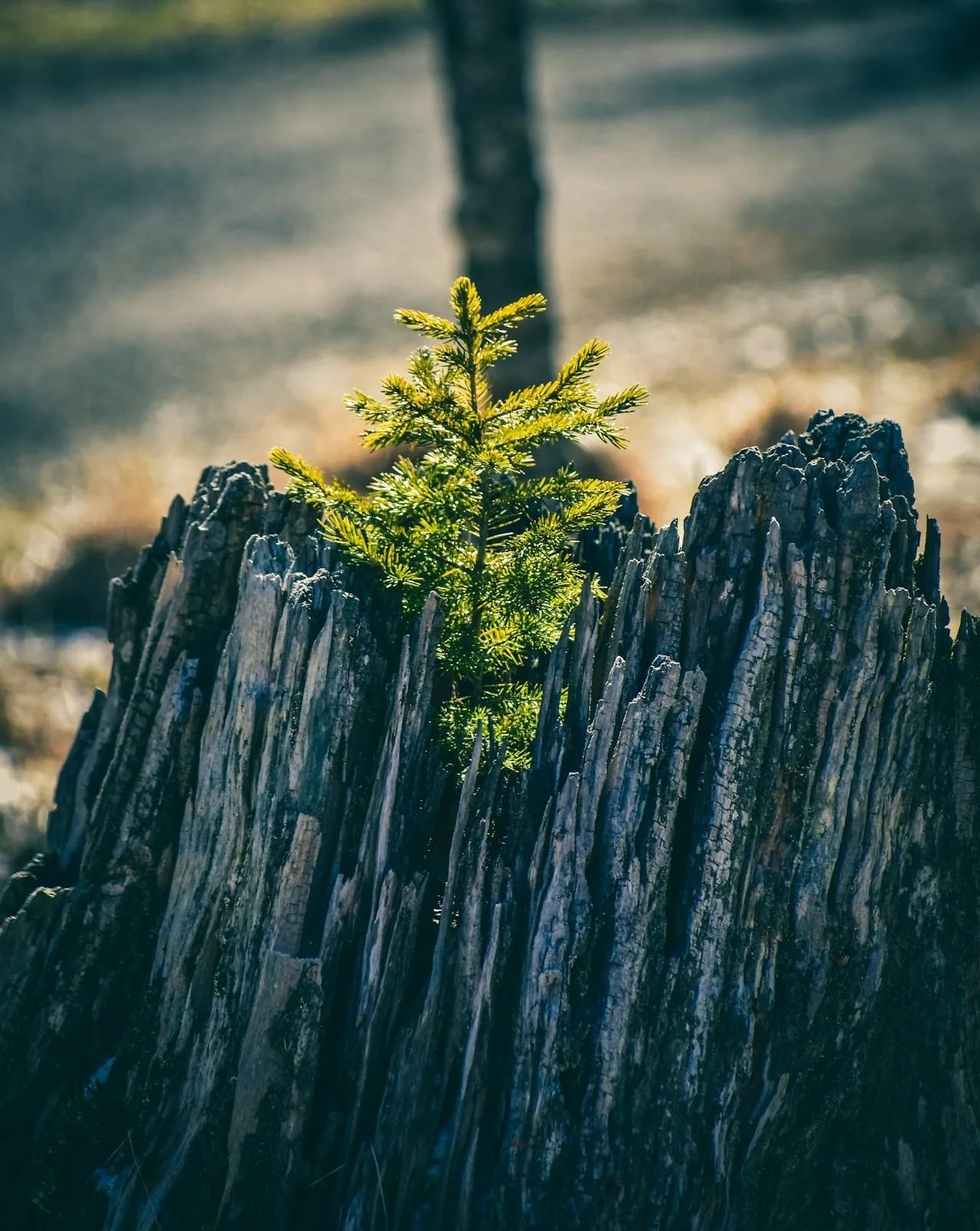
Young spruce growing from rotten trunk. Photo by Pexels member Chris F taken Feb 21, 2020.