

Our deepest loyalty
Today is the Sunday before Thanksgiving. It’s the time of year when we frantically search for old family recipes and start to think about Christmas shopping. I haven’t heard anyone singing songs about Rudolph yet, but I know that’s only a matter of time.
Today is also the last Sunday of the Church year. Next week begins Advent, the great season of anticipation, a time to ready ourselves for the birth of a baby who will change everything.
In a season such as this, you might expect to hear stories of celebration and glory, stories of comfort and of God’s triumph over evil. But instead, our lectionary hands us a crucifixion.
We call this day the feast of Christ the King. But the readings appointed for this morning remind us that Christ is a very particular sort of king. He’s not the sort of king our world expects. Caesar didn’t recognize a king who ruled by mercy. Pilate couldn’t understand a king who might refuse to save himself. And, if we’re honest, we often don’t recognize a king like that either—at least not at first glance.
The people stood by, watching Jesus on the cross. The leaders scoffed. And the soldiers mocked him. It was a criminal, dying at Jesus’s side, who recognized him for who he was. “Jesus, remember me when you come into your kingdom,” he said.
I suspect that we hear these words on this day to remind us that the kingship of Christ has never looked like the kingship of Caesar. And it never will.
When we look more closely at Luke’s description of Jesus’s crucifixion, the contrast sharpens. Every stereotype of kingship collapses under the weight of what Jesus does—and what he chooses not to do. Kings defend themselves. They rally armies, strongarm rivals, cajole allies. But Jesus refuses every one of those instincts. He doesn’t respond to taunts. He doesn’t curse. He does nothing to save himself. Instead, he forgives his killers even as he suffers and dies.
Very few of those who surround him understand. The crowd stares and the leaders sneer and the soldiers joke among themselves. It’s only a condemned criminal, a man with nothing left to offer, who somehow sees the truth. Who somehow understands the possibility of a kingdom that has nothing to do with force or fear. A kingdom made visible only in mercy.
“Jesus, remember me,” he says. “Remember me, when you come into your kingdom.” It’s not much of a prayer. But it’s enough. Enough to show that he understood who Jesus really is. A king, yes. But a king whose authority isn’t measured in power wielded or in victories won.
It’s a hard idea to accept, though. A king dying on a cross. That’s not how the world is supposed to work.
The letter to the Colossians gives us a different lens through which to see Jesus’s kingship. It’s a lens that’s maybe easier to accept—if not to fully comprehend. Christ is “the image of the invisible God, the firstborn of all creation,” “in him all things in heaven and on earth were created, things visible or invisible,” “he himself is before all things, and in him all things hold together.”
Some theologians call this the Cosmic Christ. This is the Christ of the Gospel of John: “In the beginning was the Word, and the Word was with God, and the Word was God. He was in the beginning with God. All things came into being through him, and without him not one thing came into being. What has come into being in him was life, and the life was the light of all people.”
It’s a beautiful image, a beautiful idea. But the scandal and wonder of Christian faith is that we don’t get to have one without the other. Christ is at once a suffering man dying on a cross and the one through whom all earthly thrones, dominions, rulers, and powers were created. The Christ who holds the universe together is the Christ who hangs between two criminals.
And on this day, the Church reminds us that Christ is king.
When the first Christians proclaimed Christ as king, they used the same words that the wider world used to speak of Caesar. The implication was clear. Christ is King. And Caesar is not.
Every age has its Caesars, its rulers, its systems, its forces that promise us safety, order, and prosperity—so long as we give them our allegiance. Self-proclaimed saviors claim that they alone can fix all that’s wrong with the world. Relentless voices urge us to place our hope in the rise or fall of a party, a nation, or an ideology. Conventional wisdom whispers that power comes only from winning, controlling, and dominating.
But Christ is king. And Caesar is not.
The kingship of Christ exposes our illusions. The kingship of Christ reminds us that no earthly authority, no matter how impressive or intimidating, holds any ultimate claim on us. The kingship of Christ is the kingship of one who refuses to play by the rules of fear, of one whose power is found in mercy.
Here’s where it gets tricky, though. Because if Christ is king, and Caesar is not, we’ll eventually need to decide where our loyalties lie. Jesus taught his followers, and every generation since his time has learned again, that we can’t serve two masters.
Caesar, in whatever form he takes, thrives on fear. Christ calls us to faith. Caesar insists that only the powerful matter. Christ dies among the powerless and invites them into his kingdom. Caesar tells us to protect ourselves at all costs. Christ asks us to welcome the stranger. Caesar says to hoard what we have. Christ says to share our bread. Caesar promises that might makes right. Christ shows us that love is stronger than death.
When our loyalties pull us in different directions, we should remember to look to the one lifted up on the cross. We should measure our choices, our hopes, and our fears against the pattern of his life. We should ask ourselves whether the many voices calling for our allegiance lead us toward mercy or toward domination, toward compassion or toward contempt.
If Christ is king, then our deepest loyalty must not be to whatever power promises us the most wealth or comfort or security. Our deepest loyalty must be to the one who forgave his executioners. The one who showed compassion for a dying criminal. The one who reigns with a sort of power the world has never known quite what to do with.
And maybe that’s why the Church ends this year not with triumph, but with a simple, desperate prayer: “Jesus, remember me when you come into your kingdom.”
Perhaps that ought to be our prayer as well. A prayer as we stand on the edge of a new church year, in a time that surrounds us with voices that clamor for our attention, our fear, and our allegiance. Perhaps our call is simply to say, again and again, “Jesus, remember me.” “Remember me.” “Remember us.” Remember us when we lose our way. Remember us when fear overwhelms us. Remember us when Caesar’s promises tempt us. Remember us when Caesar’s kingdom seems to be winning and God’s kingdom seems impossibly weak.
Remember us. And remind us, as often as we need to be reminded, that Christ is king, and Caesar is not.
“For in him all the fullness of God was pleased to dwell, and through him God was pleased to reconcile to himself all things, whether on earth or in heaven, by making peace through the blood of his cross.”

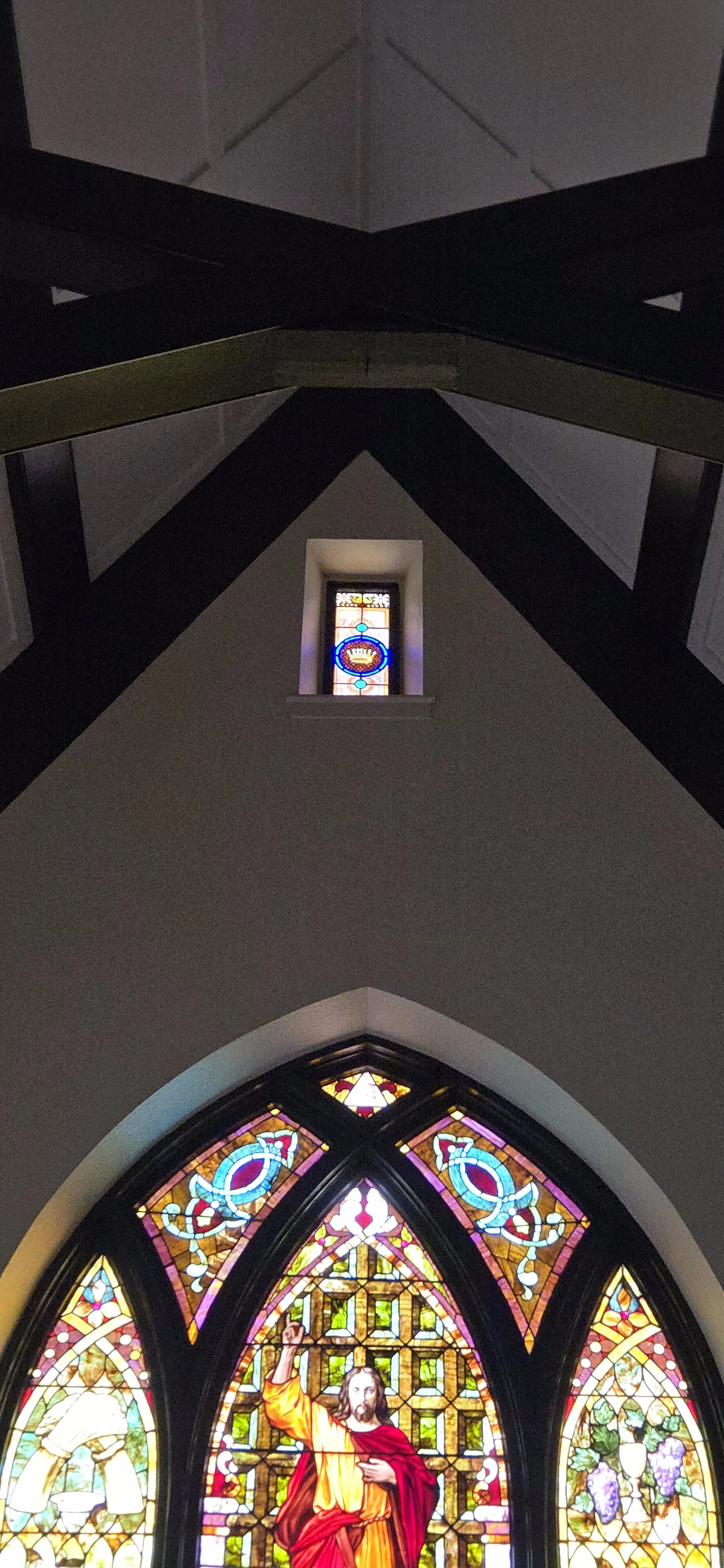
About this image: High above the large stained glass window behind the altar at our church is a small window containing a crown.